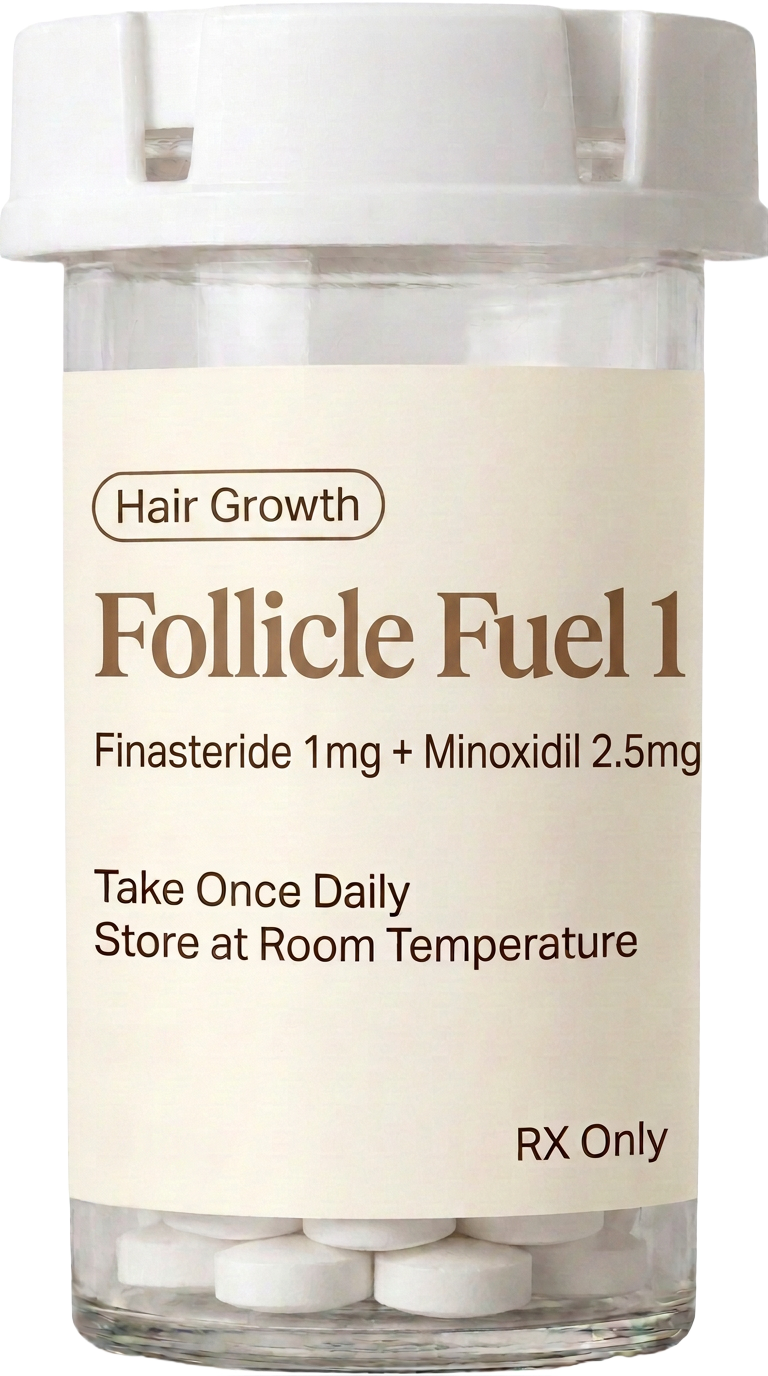
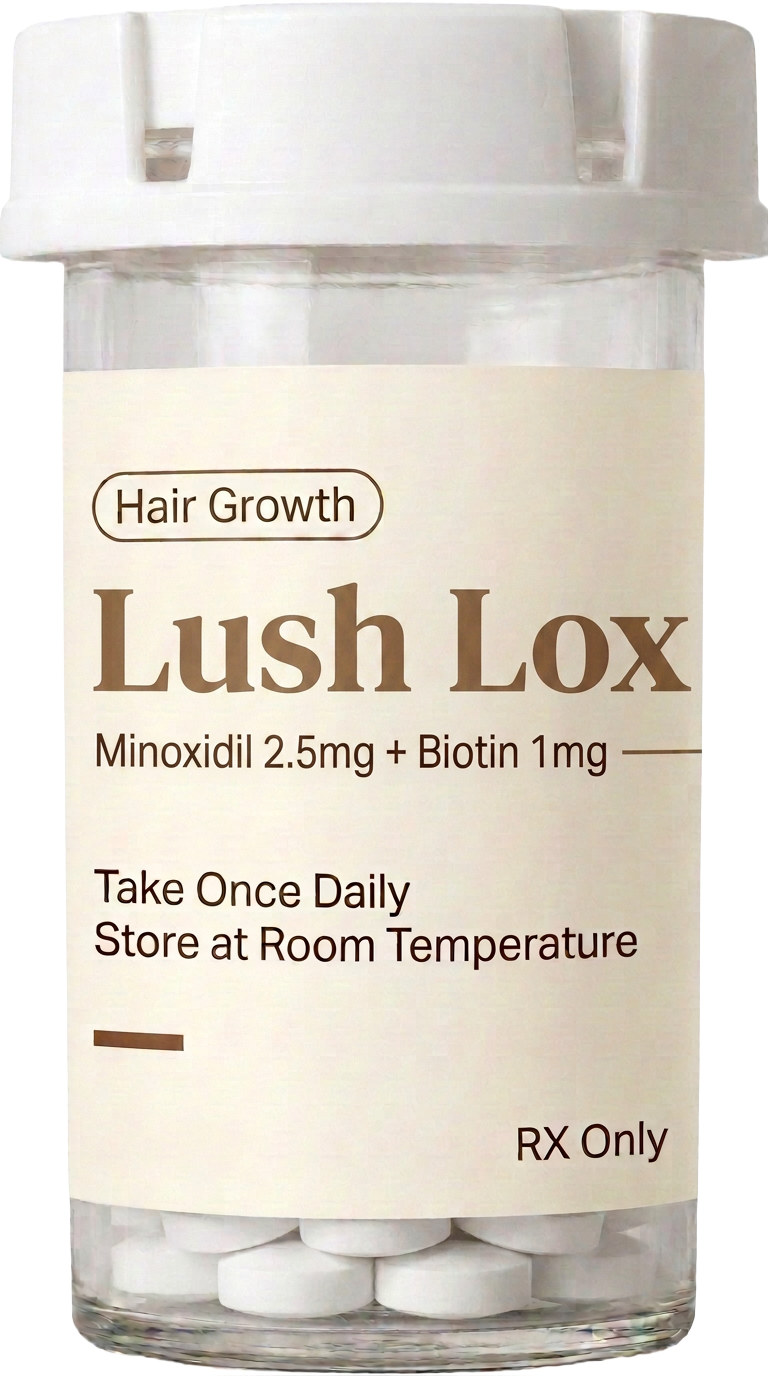
Skip the topical. Keep the results.
A low-dose oral tablet for patients who'd rather not add another step to their morning. Same active molecule, no scalp application, no residue.
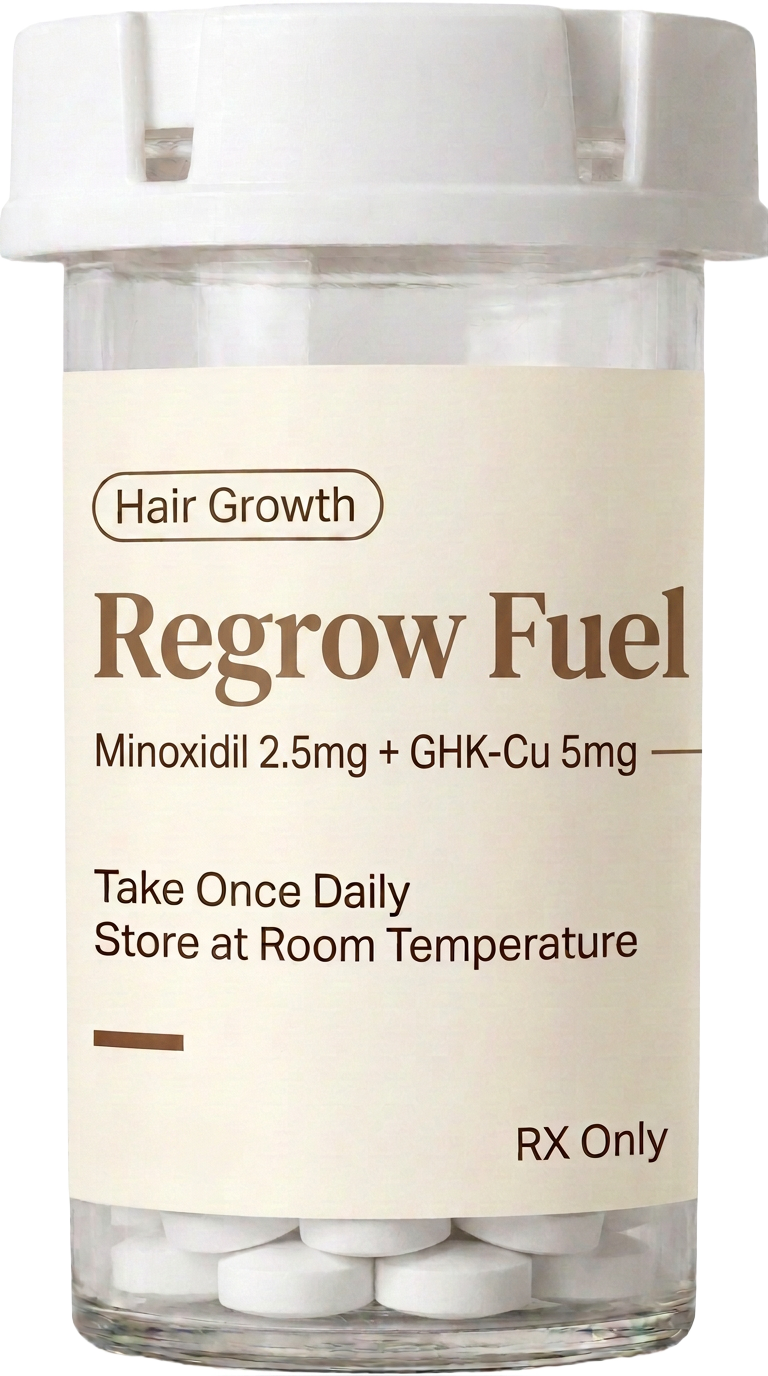
Regrow Fuel
Minoxidil 2.5 mg with GHK-Cu, apigenin and fisetin — no scalp application, no residue.
What's inside
Regrow Fuel pairs low-dose oral minoxidil with three follicle-support ingredients in one daily capsule.
- Minoxidil 2.5 mgExtends the growth phase of the hair cycle and improves blood flow to the follicle.
- GHK-Cu 5 mgA copper peptide studied for scalp and follicle support.
- Apigenin 50 mgA plant flavonoid included for its antioxidant profile.
- Fisetin 50 mgA flavonoid used alongside apigenin to support the follicle environment.
How it works
A low-dose daily tablet that widens small blood vessels and extends the growth phase of your hair cycle, giving follicles more time and better circulation to produce thicker strands.
Oral minoxidil is a good fit when a topical routine isn't practical or when a topical hasn't produced the results you were hoping for. Your clinician picks a starting dose based on your history and monitors how you respond in the first few months.
What to expect
- CadenceOne low-dose tablet daily.
- MechanismProlongs the growth phase of the hair cycle system-wide.
- TimelineReduced shedding around month 2–3, visible regrowth by month 4–6.
- Good fit ifYou've disliked topicals, or your response to topical minoxidil has plateaued.
- Side-effect patternMild fluid retention or increased body hair in some patients; monitored during follow-ups.
Who it's for
Oral minoxidil is a strong fit when a topical routine hasn't stuck — either because you didn't like the scalp application or because the results plateaued. It works from the inside, once a day.
- Adults 18+ with visible thinning across the scalp.
- Tried topical minoxidil and either disliked the routine or plateaued.
- Want to pair a hair-cycle stimulator with a DHT blocker like finasteride.
- Ready to commit to a 4–6 month evaluation window.
- —Uncontrolled low blood pressure, or on medications that interact.
- —History of pericardial or heart failure without cardiology clearance.
- —Currently pregnant, planning pregnancy, or breastfeeding.
- —Under 18, or otherwise not appropriate on clinician review.
Your first 6 months
Oral minoxidil works by extending the growth phase of your hair cycle. Response tends to arrive a little faster than finasteride, but the same rule holds: monthly photos are a much better metric than the mirror.
- Months 1–2Adjustment window
Some patients see mild early shedding as follicles cycle into a new growth phase — this is expected and short-lived. Your clinician monitors for fluid retention and adjusts if needed.
- Months 3–4Regrowth becomes visible
Fine new hairs appear at the hairline and across the crown. Existing hairs feel thicker as the growth phase extends.
- Months 5–6Density and coverage stabilize
By month six, most patients see meaningful density improvement in photos. Your clinician reviews response and adjusts dose or stacks with finasteride if appropriate.
Minoxidil rebuilds. Finasteride defends.
Oral minoxidil drives regrowth, but it doesn't stop the DHT that keeps shrinking follicles in the first place — that's finasteride's job. Used together they consistently outperform either one alone, and your clinician decides whether stacking makes sense for you.